
The Intensive Care Unit is characterized by its fast-paced environment, and patient outcomes are reliant on how teams can collaborate and efficiently work together. Multidisciplinary collaboration between nurses, doctors, physicians, pharmacists, and more are critical to ICU operations.
Why Multidisciplinary Collaboration Matters
When acute care teams work in unison, they produce better quality, precise care. Research has proven that hospitals which adopt and prioritize multidisciplinary strategies report lower mortality rate and higher patient reviews. This is in part due to the fact that collaboration between various hospital roles counteracts potential “silo effects”, where there is not diversity in thought patterns and approaches (Epstein, 2014). In addition to improved problem solving, collaborative initiatives in the ICU make way for better communication and stronger working conditions for facility staff (Weller et al, 2024). Effective teamwork processes, such as morning meetings and shared training, were 2.8 times more likely to have improved mortality and morbidity rates (Schmutz et al, 2013). Some studies even determined that gestures as simple as knowing other staff members’ names, being friendly, and using open body language in team settings led to improved patient outcomes (Abdulghafor, et al). Key benefits include increased patient safety, as easy communication reduces risks of medication errors, and faster clinical decision-making from shared expertise between staff on the team.
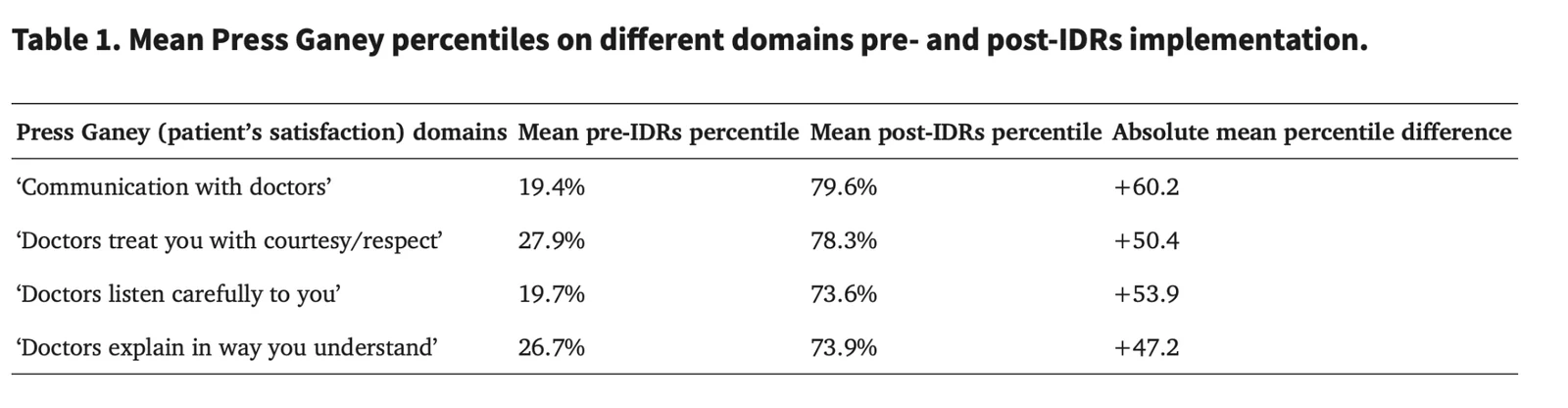
The above table, taken from Weal Ghali’s “Enhancing Patient Satisfaction and Experience Through Bedside Interdisciplinary Rounds: a Quality Improvement Study”, shows the change in patient satisfaction domains before and after interdisciplinary discussion between doctors nurse leaders, medical residents, and social workers regarding patient management was implemented for 7 months.
The Takeaway
Effective collaboration in the TeleICU leads to improved team cohesion, health outcomes, and patient satisfaction. When professionals utilize team building and communication and share knowledge, it makes care more coordinated and compassionate. Overall, multidisciplinary efforts in the ICU are the foundation of improved care.
References
Ghali W, Abu-Shanab A, Bhanderi H, Lewis K, Grant E, Granet K. Enhancing patient satisfaction and experience through bedside interdisciplinary rounds: a quality improvement study. BMJ Open Qual. 2025 Apr 21;14(2):e003314. doi: 10.1136/bmjoq-2025-003314. PMID: 40258640; PMCID: PMC12015713.
Jennifer M. Weller, Ravi Mahajan, Kathryn Fahey-Williams, Craig S. Webster,
Teamwork matters: team situation awareness to build high-performing healthcare teams, a narrative review, British Journal of Anaesthesia, Volume 132, Issue 4, 2024, Pages 771-778,
ISSN 0007-0912, https://doi.org/10.1016/j.bja.2023.12.035.
Abdulghafor R, Turaev S, Ali MAH. Body Language Analysis in Healthcare: An Overview. Healthcare (Basel). 2022 Jul 4;10(7):1251. doi: 10.3390/healthcare10071251. PMID: 35885777; PMCID: PMC9325107.
Schmutz JB, Meier LL, Manser T. How effective is teamwork really? The relationship between teamwork and performance in healthcare teams: a systematic review and meta-analysis. BMJ Open. 2019;9(9):e028280. doi:10.1136/bmjopen-2018-028280.
